CURRENT WORK
Emma is in the early stages of a new book project, provisionally titled Music, Work, and Social Movement in Belle Époque Paris, 1871-1914. The years between 1871 and 1914 in France, commonly known as the Belle Époque, have traditionally been considered a time of cultural and consumerist excess, characterised by a seemingly boundless optimism that would only be halted by the outbreak of the First World War. However, the French capital was also a site of great political activity, as working people mobilised with ever-increasing power to initiate social change. Yet despite their lasting influence on French cultural life, these social currents have thus far been largely overlooked in our musical histories of the period. This project therefore asks: what was the role of music in social change in France during the Belle Époque, and how do these lived histories of music challenge the dominant narratives of the period?
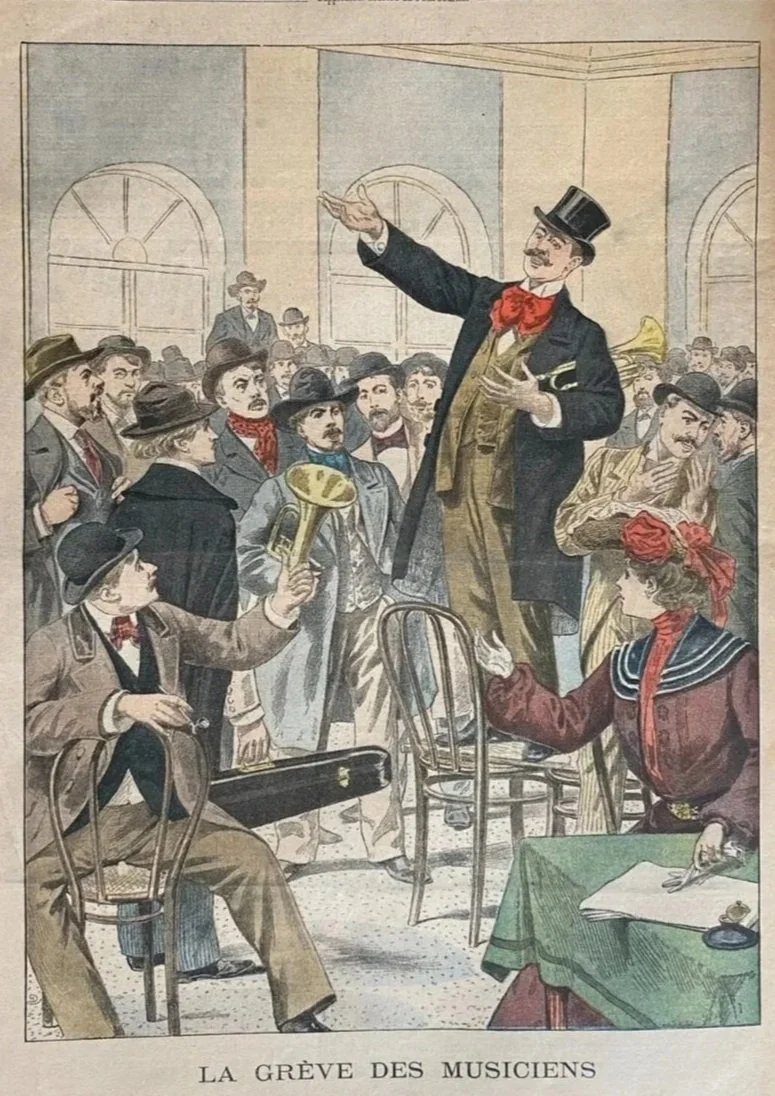
This project thus looks to recast the dynamics of music, labour, and working-class social movement in Paris between the Franco-Prussian and First World Wars through four case studies: the musical life of the capital’s major department stores, Gustave Charpentier’s Conservatoire Populaire, music in social clubs for provincial migrants, and the Musicians’ Strike of 1902. Through these lines of enquiry, this research aims to argue that music played a pivotal role in social movement at the fin de siècle, and operated differently in top-down social initiatives compared to bottom-up socialist movements. In the hands of philanthropists, patrons, and business owners, music could serve as a means of social “improvement” for the working classes; for the workers themselves, music became a crucial cultural axis around which communities could form. This research therefore looks to embrace and complicate this dualism, and to illuminate how Belle Époque ideas about creativity and work continue to influence cultural life in France today.